Vapor Barrier Installation in Kernersville, NC
Vapor barrier installation is the service of laying and sealing a heavy polyethylene liner across the ground and up the walls of a home's crawl space so that soil moisture cannot enter the crawl space air. It is offered for homeowners in Kernersville, North Carolina and the surrounding Triad whose crawl space has no barrier, a torn or partial barrier, or pooling water under a failed liner. The outcome is a sealed ground surface that blocks the constant upward migration of water vapor from the soil, which is the single biggest moisture source in most crawl spaces.
Call (336) 276-2092 for a free quoteGET A FREE QUOTE
What does vapor barrier installation involve?
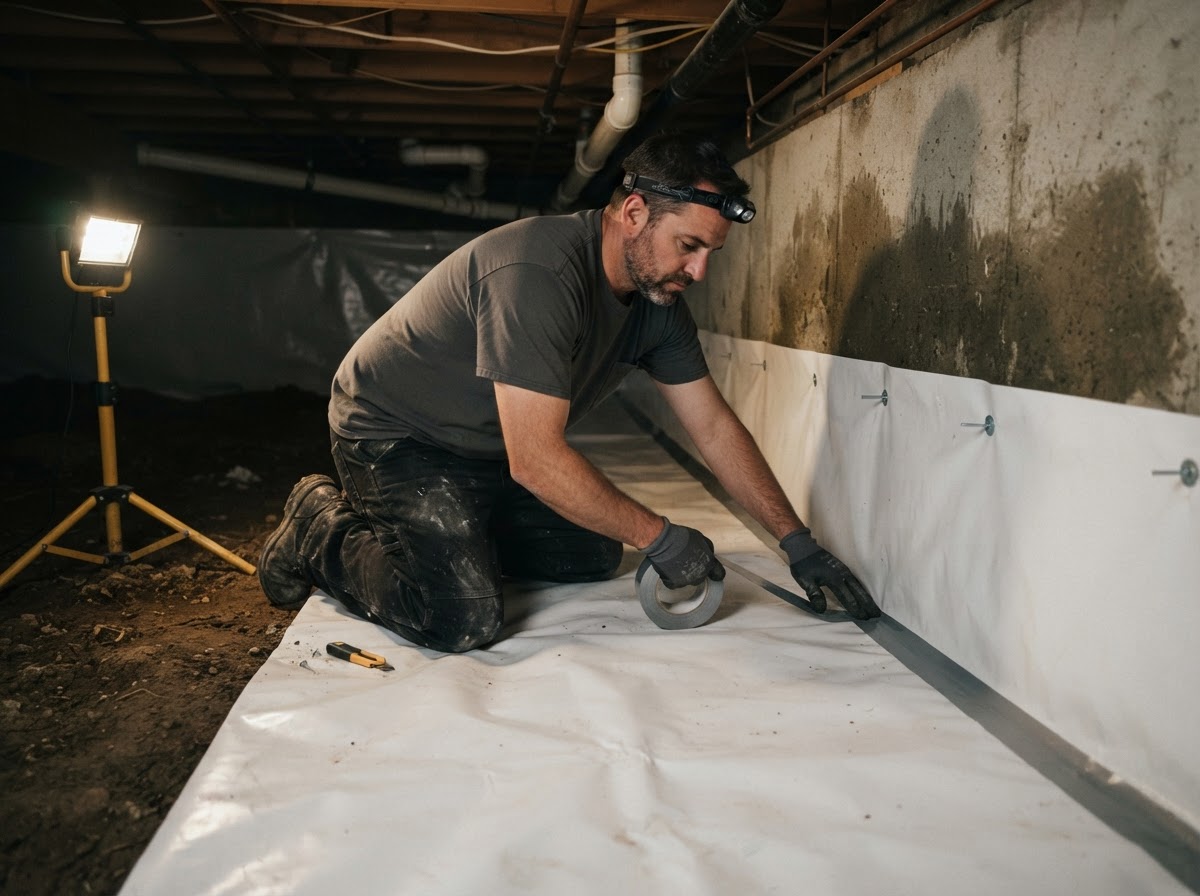
A vapor barrier is the physical liner that separates the crawl space air from the soil, and installing it correctly is what determines whether it works. The process uses a reinforced polyethylene sheet — typically 12 to 20 mils thick for crawl space use, far heavier than the thin plastic some homes have — laid across the entire ground surface. Every seam is overlapped and taped, the liner is run up the foundation walls to a set height and fastened and sealed at the top, and every penetration (piers, pipes, support posts) is wrapped and sealed so there are no gaps for vapor to slip through. In a full encapsulation the barrier is paired with sealed vents, a sealed door, and a dehumidifier; the barrier alone stops ground vapor, while the full system also stops humid air and conditions the space.
When do you need a new vapor barrier?
You need a new vapor barrier when the existing one is missing, inadequate, or failing. The signs include:
- No liner at all — bare soil exposed in the crawl space, the most common situation in older Kernersville homes.
- A thin (6-mil or lighter) plastic sheet that is torn, bunched up, or only partially covering the ground.
- Pooled water sitting on top of the existing liner, meaning it is holding water instead of sealing it out.
- A liner that has pulled away from the walls or has unsealed gaps around piers and pipes.
- High crawl space humidity and musty smells even though a barrier is present, indicating it is not doing its job.
- A crawl space being encapsulated that needs a proper heavy liner as the foundation of the system.
Why does ground moisture matter so much in Kernersville?
In the Piedmont, the soil under a home is constantly releasing water vapor — clay soil in particular holds water after rain and gives it off slowly over days. In an unsealed crawl space, that vapor rises straight into the air under your home, raising the humidity that condenses on wood and ductwork and feeds mold. A bare-soil crawl space can release gallons of water vapor per day during humid periods, which is why sealing the ground is the first and most important step in drying the space. The barrier works by giving that vapor nowhere to go — it stays trapped under the liner instead of entering the air. Without it, no dehumidifier can keep up with the load.
It is the same across the Kernersville 27284 and 27285 zip codes in Forsyth County, where clay soil under vented crawl spaces releases moisture into the air day after day. It is one of the most common reasons homeowners contact us for crawl space services in Kernersville.
What affects the cost of vapor barrier installation?
Cost is driven by the crawl space's square footage and perimeter length (which determines how much liner is needed and how much wall coverage there is), the thickness and quality of the liner material, the number of piers and penetrations that have to be wrapped and sealed, and the access and clearance of the space. Removing an old failed liner and any debris adds to the scope — see crawl space cleanout & debris removal. If the barrier is being installed as part of a full encapsulation, it is bundled with vent sealing, a dehumidifier, and any waterproofing. Your written quote itemizes the liner scope and the cost drivers behind it.
Vapor barrier alone or full encapsulation — which do you need?
A vapor barrier alone stops ground vapor, which is the largest single moisture source, but it does not stop humid outside air from entering through open vents or a leaky door. Full encapsulation adds vent and door sealing plus conditioning (a dehumidifier or tied-in air) to address those additional sources. For a crawl space with a minor ground-moisture problem and good ventilation, a barrier alone may be enough. For a crawl space with high humidity, musty smells, or mold, the full system is the durable fix. The inspection determines which scope fits your home and budget.
What does the vapor barrier installation process look like?
- Inspection. The crawl space is inspected for existing barrier condition, ground moisture, water entry, and any mold or debris.
- Written quote. You receive a quote specifying the liner thickness, coverage area, and any encapsulation components needed.
- Cleanout. The old liner (if any), debris, and failed insulation are removed so the ground is clear.
- Water management. If water collects on the ground, a sump or drainage is installed first so the new liner is not sitting in water.
- Liner installation. The polyethylene is laid across the ground, seams are taped, the liner is run up the walls and fastened, and piers and penetrations are wrapped and sealed.
- Sealing and conditioning. If part of an encapsulation, vents and doors are sealed and a dehumidifier is installed.
- Final check. The crew verifies full coverage and sealed seams and walks you through the finished liner.
Frequently asked questions
How thick should a crawl space vapor barrier be?
Crawl space use calls for a reinforced liner in the 12-to-20-mil range, much heavier than the thin 6-mil plastic sometimes laid as a temporary cover. A heavier liner resists tearing when the crawl space is accessed, lasts longer, and seals better at the seams. The inspection recommends the right thickness for your space and how the crawl space is used.
Will a vapor barrier stop the musty smell?
A vapor barrier stops the ground moisture that feeds mold, which is usually the source of the musty smell. If the smell is coming from existing mold on the wood, that growth also needs to be treated — see crawl space mold removal. The barrier prevents the moisture that would let mold return, so the two often go together.
What if water pools under the liner?
If water collects under the liner, the barrier is holding it instead of keeping it out, which means a water source — seepage at the footing or a high water table — needs to be managed first. That is why the inspection checks for water entry before installing a liner, and a sump pump or drainage is added as part of the job when needed.
How long does a vapor barrier last?
A heavy reinforced liner installed and sealed correctly lasts many years. The seams and the areas around piers and the access door are the points to check over time, and any encapsulation system should be inspected periodically to confirm the liner is intact and the dehumidifier is holding humidity. The inspection covers what ongoing maintenance your system will need.
What happens if I leave the crawl space with no barrier?
Bare soil releases water vapor constantly, so humidity stays high, mold and wood rot take hold, and the musty smell and indoor humidity persist. A vapor barrier is the single most effective step for cutting that moisture load, and skipping it means any dehumidifier or encapsulation work has to fight a losing battle against the ground.