Crawl Space Encapsulation in Kernersville, NC
Crawl space encapsulation is the service of sealing a home's crawl space — the ground, the walls, and the vents — so that soil moisture and humid outside air can no longer enter the space, and then conditioning the air inside so it stays dry. It is offered for homeowners in Kernersville, North Carolina and the surrounding Triad whose vented or partially sealed crawl space is causing musty smells, high indoor humidity, mold growth, or damp insulation. The outcome is a clean, dry, conditioned crawl space that stops being a source of moisture for the rest of the house.
Call (336) 276-2092 for a free quoteGET A FREE QUOTE
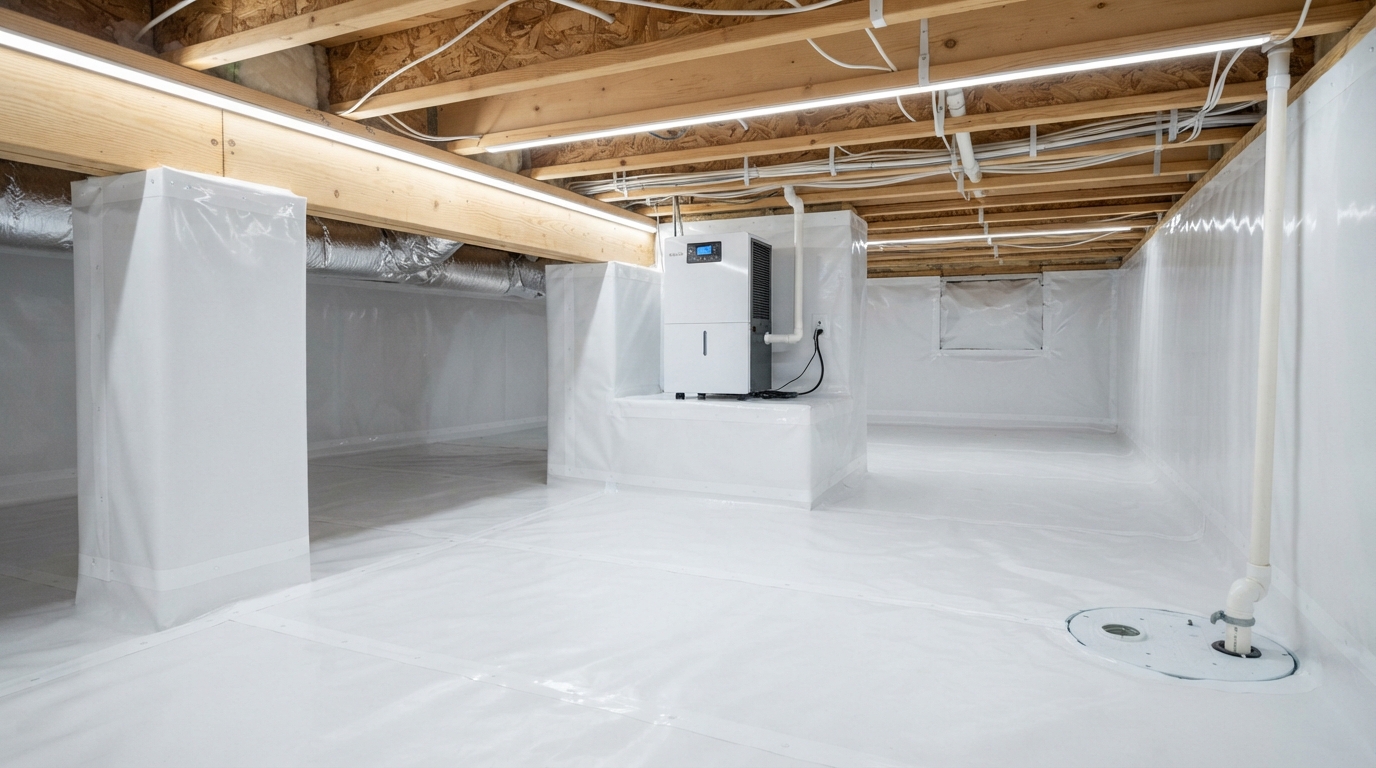
What does crawl space encapsulation involve?
A full encapsulation has several parts that work together. The ground is covered with a heavy polyethylene vapor barrier — typically 12 to 20 mils thick — that is taped and sealed at every seam and run up the foundation walls to a set height. The crawl space vents are sealed and the access door is replaced or gasketed so humid outside air stops flowing through. Any existing insulation that has absorbed moisture is removed. The space is then conditioned, either by adding a crawl space dehumidifier sized to the volume or by tying the crawl space into the home's conditioned air. Where water collects, a sump pump may be added under the liner. The result is a sealed, dry space that is no longer exchanging air with the wet ground or the humid outdoors.
When do you need crawl space encapsulation?
Encapsulation is the right call when the crawl space is acting as a moisture source for the home. The signs are specific:
- A persistent musty smell inside the house, especially when the HVAC runs and pulls air up from the crawl space.
- High indoor humidity in summer that the HVAC struggles to keep up with.
- Visible mold, dark staining, or white fuzzy growth on the wood joists or subfloor.
- Wet or pooled water on the ground, or a thin existing vapor barrier that is torn, sagging, or only partially covering the soil.
- Cupping or buckling hardwood floors above the crawl space, caused by moisture migrating up through the subfloor.
- Fiberglass insulation that has fallen out of the joist bays in damp clumps.
If you are seeing several of these, the crawl space is no longer something you can leave vented. Encapsulation is the standard fix.
Why do crawl spaces in Kernersville get so wet?
Two local factors combine. First, the Piedmont's clay-heavy soil holds water after rain and releases it slowly as vapor, so the ground under a Kernersville home is constantly breathing moisture into the crawl space air. Second, the region's long humid season means that for much of the year the outside air holds more water than the cooler air inside the crawl space — and when that warm humid air enters through open vents, it condenses on the cooler wood and ductwork. That condensation is what raises wood moisture above the level where mold and rot take hold. Older vented crawl spaces, common in Triad housing stock, were designed before this was well understood; the vents that were supposed to dry the space actually feed it humidity. Encapsulation works by cutting both sources off — the ground vapor and the vented air — and then holding the remaining air dry.
Most homes across Kernersville's 27284 and 27285 zip codes, throughout Forsyth County, were built with these vented crawl spaces, so the ground-vapor-and-condensation pattern repeats from downtown neighborhoods out to the county's rural edges. It is one of the most common reasons homeowners contact us for crawl space services in Kernersville.
What affects the cost of encapsulation?
Encapsulation cost is driven by the crawl space's square footage and perimeter length, the height and accessibility of the space (low clearance and many piers slow the work), the thickness and coverage of the vapor barrier, whether the walls are insulated as part of the seal, and whether a dehumidifier, sump pump, or drainage is needed to keep the sealed space dry. Pre-existing mold and debris removal add to the scope. See the crawl space encapsulation cost page for the full framework — no two quotes are the same because no two crawl spaces are.
Encapsulation vs. leaving the crawl space vented — which is right?
The old approach was to leave crawl spaces vented and hope cross-ventilation kept them dry. In a humid climate like central North Carolina's, that approach has been shown to fail: the vents bring in more moisture than they remove. Encapsulation — sealing and conditioning — is now the recommended approach for this region. The decision is rarely "encapsulate vs. do nothing"; by the time a homeowner is researching it, the crawl space is already causing problems. The real decision is how far to go: a ground-only vapor barrier helps less than a full wall-to-wall sealed system with conditioning, and the inspection determines which scope fits your home and budget.
What does the encapsulation process look like?
- Inspection and quote. The crawl space is inspected for moisture, mold, water entry, and existing barrier condition. You receive a written quote with the recommended scope.
- Cleanout. Old insulation, debris, and any pooled water are removed, and mold is treated so the space is clean before sealing.
- Water management. If water enters the space, a sump pump or drainage is installed first so the sealed liner is not sitting on a water source.
- Vapor barrier installation. The liner is laid across the ground, sealed at the seams, and run up the walls, with piers and penetrations wrapped and taped.
- Sealing vents and doors. Vents are closed and insulated, and the access door is sealed or replaced.
- Conditioning. A dehumidifier is installed (or the space is tied to conditioned air) to hold humidity below the mold threshold.
- Final check. Humidity targets are verified and the finished space is walked through with you.
Frequently asked questions
How long does an encapsulation last?
A properly installed encapsulation with a heavy liner and a working dehumidifier is a long-term solution — the liner itself lasts many years, and the sealed space stays dry as long as the dehumidifier and any sump pump are maintained. The system does need occasional checks: the dehumidifier filter, the sump pump, and the liner seams should be inspected periodically. The inspection covers what ongoing maintenance your specific system will need.
Will encapsulation get rid of the musty smell?
In most cases yes, because the smell is caused by mold and high humidity in the crawl space, and encapsulation removes both the moisture source and, with mold treatment, the growth itself. If the smell is coming from a different source — a leak upstairs, for example — the inspection will identify that before any work is done.
Do I still need a dehumidifier if the crawl space is sealed?
Usually yes. Sealing stops new moisture from entering, but a small amount of moisture still migrates through concrete and through the air handling system. A dehumidifier sized to the crawl space volume holds the relative humidity below the level where mold grows. Without it, a sealed space can still climb above that threshold during a humid Kernersville summer.
How disruptive is the work to my home?
The work happens entirely under the house, so the living space above is not disrupted. You will hear crew activity and see equipment, and the access to the crawl space is used throughout, but there is no demolition inside the home. Most encapsulation projects are completed in a few days.
What happens if I leave the crawl space vented and wet?
The moisture keeps feeding mold and wood rot, the musty smell intensifies, indoor humidity stays high, and over time the wood framing loses strength — which turns a moisture problem into a structural one. Addressing it early with encapsulation is cheaper than waiting until joists need replacement.