Sump Pump Installation in Kernersville, NC
Sump pump installation is the service of installing a sump basin and pump inside a home's crawl space to collect water that enters at the low point or along the footing and eject it outside and away from the foundation. It is offered for homeowners in Kernersville, North Carolina and the surrounding Triad whose crawl space has standing water, seepage, or a high water table that drainage alone cannot manage. The outcome is a crawl space where incoming water is automatically pumped out before it can pool, protecting the wood, the vapor barrier, and any encapsulation above it.
Call (336) 276-2092 for a free quoteGET A FREE QUOTE
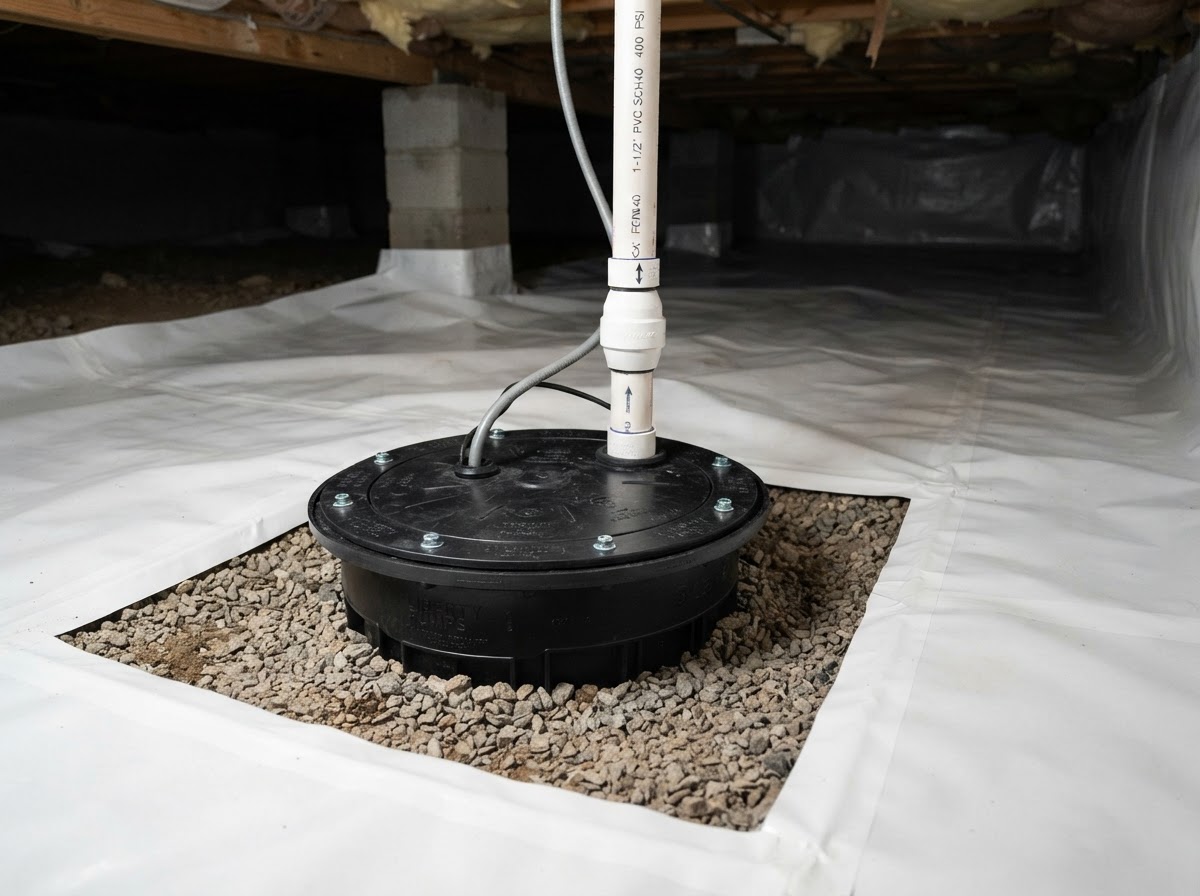
What does sump pump installation involve?
A sump pump system has three parts: the basin (a pit dug at the low point of the crawl space that collects water), the pump itself (which sits in the basin and switches on when the water rises), and the discharge line (a pipe that carries the water outside and away from the foundation). Installation means excavating or setting the basin at the right depth, tying any interior perimeter drainage into it, dropping in the pump, and running the discharge line to a point well clear of the house — often with a backup pump added so the system keeps working during a power outage or primary-pump failure. In an encapsulated crawl space the sump sits under the vapor barrier, so water is managed before it reaches the sealed space.
When do you need a sump pump in the crawl space?
A sump pump is needed when liquid water is actually collecting under the home. The signs include:
- Standing water or muddy soil in the crawl space after normal Piedmont rains.
- Water entering at the wall-to-floor joint or through the footing.
- An existing sump pit that is empty, crumbling, or has a pump that no longer runs.
- A high water table that pushes water up through the crawl space floor during wet seasons.
- Water pooling under a vapor barrier that is supposed to keep the ground dry.
- A crawl space being encapsulated where water entry means a pump is required to protect the seal.
Why does water collect in Kernersville crawl spaces?
Two local factors drive water entry. The Piedmont's clay soil drains slowly, so heavy rain saturates the ground around the foundation and the water presses against the footing until it finds a way in — usually at the wall-to-floor joint or through footing cracks. In lower-lying parts of the Triad, the water table can also rise during wet seasons and push water up through the crawl space floor. Homes with minimal exterior drainage — short downspouts, flat or negative grading — see more of this because surface water is directed toward the foundation instead of away. A sump pump works by giving that water a collection point and an automatic way out, so it does not spread across the crawl space floor.
It is the same across the Kernersville 27284 and 27285 zip codes in Forsyth County, where clay soil and limited exterior drainage push water toward the footing after heavy Piedmont rains. It is one of the most common reasons homeowners contact us for crawl space services in Kernersville.
What affects the cost of sump pump installation?
Cost is driven by the type and capacity of the pump (higher horsepower and backup pumps cost more), whether a backup pump (battery or water-powered) is included, the depth and difficulty of setting the basin, the length of the discharge line run to a safe exit point, whether interior perimeter drainage is tied into the basin, and whether a dedicated electrical outlet needs to be added. Replacing a failed pump in an existing pit is less involved than a first-time installation. Your written quote specifies the pump, the basin, the discharge routing, and any backup, with the cost drivers behind each.
Primary pump or primary plus backup — which do you need?
Every crawl space with water entry needs a primary pump. Whether you also need a backup depends on how much water the crawl space takes on and how reliable your power is. A backup pump (battery or water-powered) takes over if the primary fails or the power goes out — which in a storm is exactly when the most water is entering. For crawl spaces with significant water entry, a backup is strongly recommended; for minor occasional seepage, a primary may be enough. The inspection helps you decide based on the water volume and your situation.
What does the sump pump installation process look like?
- Inspection. The crew identifies where water enters, the low point for the basin, and the best discharge point outside.
- Written quote. You receive a quote specifying the pump, basin, discharge line, backup, and any electrical work.
- Basin installation. A pit is dug or set at the low point, and any interior drainage is tied into it.
- Pump installation. The primary pump (and backup, if specified) is set in the basin and connected.
- Discharge line. A pipe is run from the pump to a discharge point well clear of the foundation, with a check valve to prevent backflow.
- Electrical. The pump is plugged into a dedicated outlet or wired in, with any needed electrical work completed.
- Testing. The system is tested with water, and the discharge point is verified to move water away from the home.
Frequently asked questions
How long does a sump pump last?
A sump pump is a mechanical device with a finite lifespan, and it should be checked periodically and replaced when it shows signs of wear or stops cycling correctly. That is why a backup pump is recommended for crawl spaces with significant water entry — so the space stays dry even if the primary fails. The inspection covers what redundancy your situation calls for and the maintenance schedule for your pump.
Where does the discharged water go?
The discharge line carries the water to a point outside and well away from the foundation — never to a spot that would let it flow back toward the house. The exact discharge point depends on your lot's grading and is chosen during the inspection so the water does not simply re-enter the crawl space.
Does a sump pump need a permit?
The pump installation itself typically does not require a permit, but any electrical work for the dedicated outlet may. Exterior discharge routing that ties into a storm system may also have local requirements. The specifics for your property are confirmed during quoting.
Will a sump pump solve my crawl space moisture problem?
A sump pump removes liquid water, but it does not address humidity — the moisture that enters as vapor through the soil and air. A pumped crawl space still needs a vapor barrier and usually a dehumidifier to hold the air dry. The pump handles the water; the barrier and dehumidifier handle the humidity.
What happens if the pump fails and I do not have a backup?
The water that the pump was ejecting collects in the basin and then spreads across the crawl space floor, soaking the vapor barrier, raising humidity, and eventually threatening the wood with rot. A backup pump is the protection against that scenario, especially during storms when both water entry and power outages peak.